AGGIORNAMENTI
Cerca
Cronache degli altri

24 Marzo 2023 - 10:27

Un racconto appassionato della battaglia delle arance vissuta in presenza. La cronaca raccontata con gli occhi di chi "stenta a crederci" e ci prova pure a tirare qualche arancia ma non riuscirà mai a calarsi nella parte fino in fondo. E' il reportage (testo in italiano e in inglese) del giornalista Jon Mooallem del New York Times che sta diventando virale in tutto il Canavese.
Sembrava che stesse per scoppiare una guerra. Ed è scoppiata. L'ultima domenica del mese scorso, in una città del nord Italia chiamata Ivrea, le facciate degli edifici storici coperte con lastre di plastica e reti. Le vetrine dei negozi rinforzate con compensato e teloni. E in diverse piazze centinaia di casse di legno impilate fino a quattro metri (piedi) di altezza e ancora più larghe. Le casse sembravano delle barricate, ma erano depositi di armi. All'interno c'erano le arance.
Nel corso dei successivi tre giorni, 8.000 persone avrebbero lanciato 900 tonnellate di arance l'una contro l'altra, una alla volta, mentre decine di migliaia di altre persone se ne sarebbero state a guardare. Lo avrebbero fatto brutalmente, spesso urlando insulti ai propri obiettivi o come Braveheart, e avrebbero lanciato le arance per ore, fino a quando le sopracciglia non si fossero riempite di polpa e le camicie non si fossero completamente impregnate. E avrebbero continuato a sorridere e a lanciare le arance, abbracciandosi, scherzando e incitandosi l'un l'altro, mostrandosi euforici, con un senso di abbandono e appartenenza - una libertà facile da invidiare ma difficile da comprendere.
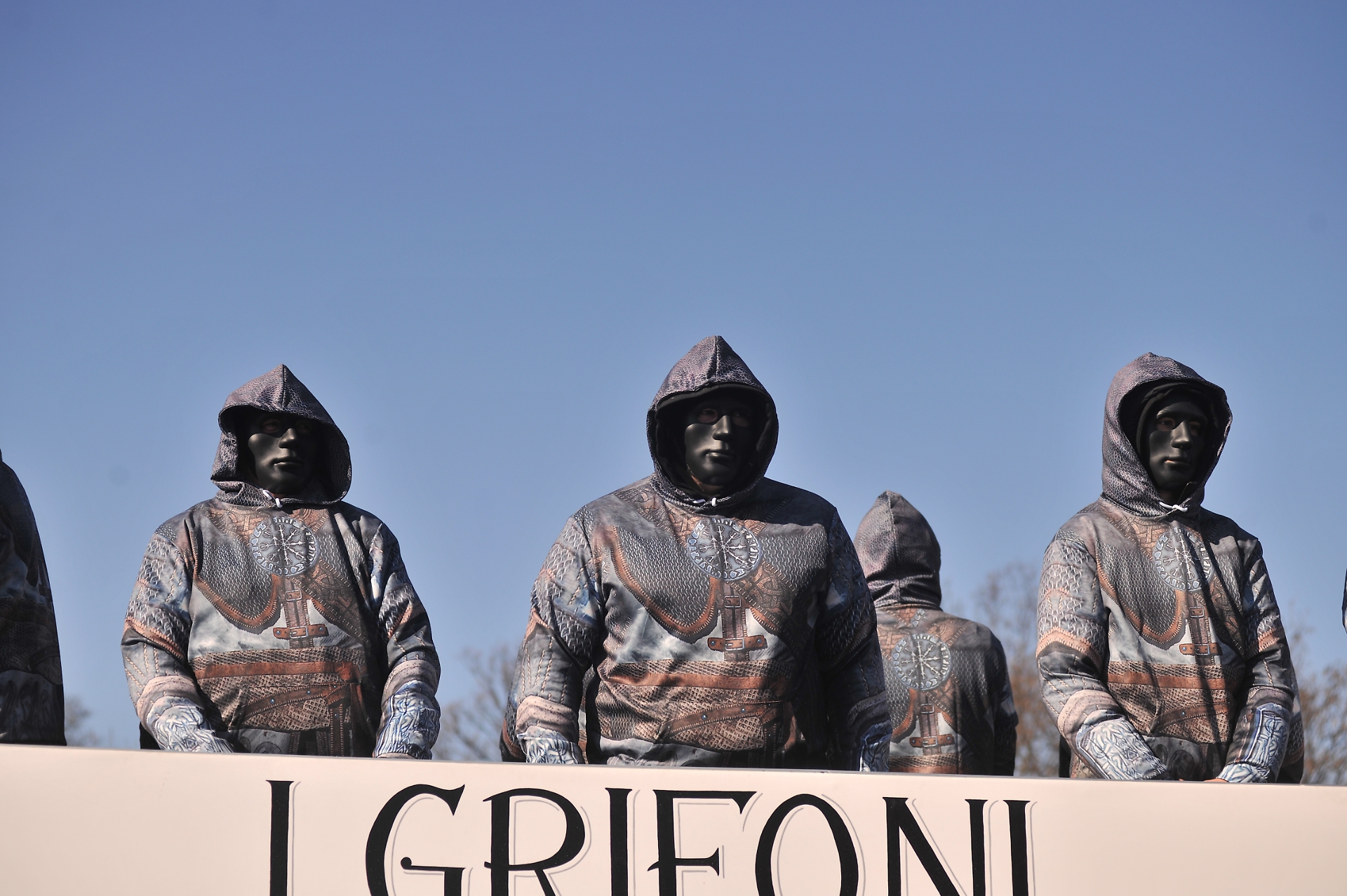
La Battaglia delle Arance è una tradizione di Ivrea e fa parte di una celebrazione più ampia descritta dai suoi organizzatori come "il carnevale storico più antico d'Italia". Tre anni fa, tutto è cominciato come sempre, con alcuni lanci, ma poi la battaglia è stata interrotta improvvisamente dal Covid.
Diversi abitanti di Ivrea mi hanno detto che nei due anni di pandemia si son preoccupati che qualcosa di brutto potesse accadere - che un'energia sinistra e repressa potesse esplodere. Ma non è successo. Ce l'hanno fatta. E ora, l'odore di agrumi immagazzinati si mescola con il muschio deimuri secolari. Gli aranceri di Ivrea sono pronti.
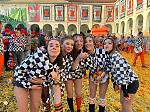
Gli aranceri di Ivrea sono organizzati in nove squadre, ognuna con una bandiera, un logo, un capitano e una uniforme. Hanno nomi come i Diavoli, i Mercenari, le Pantere Nere, la Morte.
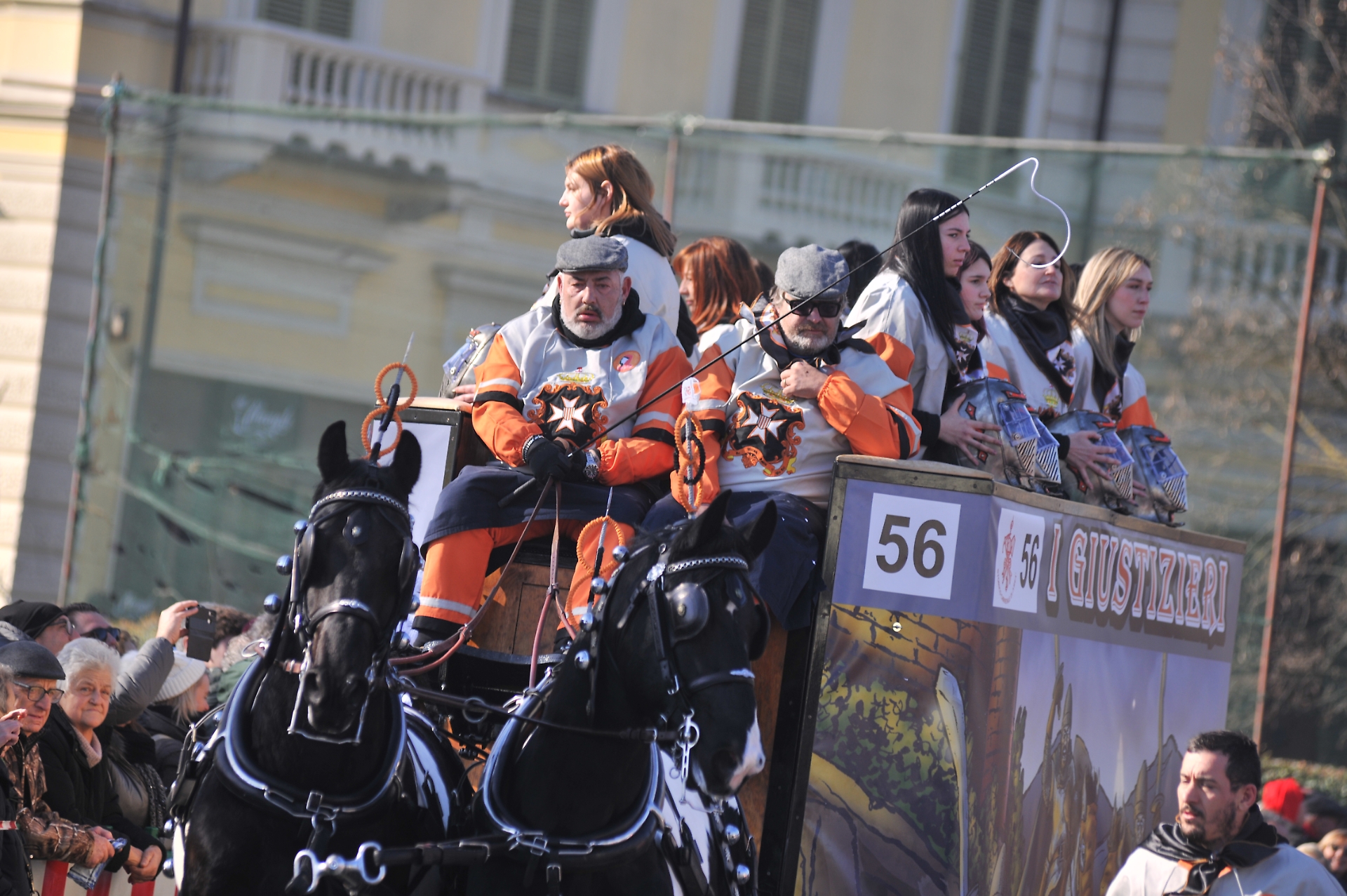
Mentre le 14:00 si avvicinano, gli arancieri si accalcano spalla a spalla nelle piazze assegnate, ognuno in attesa di combattere contro 47 brigate di altri lanciatori di arance che verranno a saccheggiare la città su carri trainati da cavalli. Molti hanno festeggiato fino alle 2 o 3 di notte e molti stanno bevendo anche quella mattina; la città è invasa da bicchieri usa e getta di vino caldo speziato e di Bombardino, una bevanda alcolica simile a un eggnog servita calda.
Sono prevalentemente uomini, soprattutto giovani, ma ci sono anche molte donne. Ci sono anche persone anziane che partecipano alla Battaglia delle Arance fin da quando avevano l'età di quei giovani. Alcuni hanno portato i propri figli alle loro prime battaglie nei passeggini, 20 anni fa. (Una donna mi ha mostrato una foto con orgoglio.)
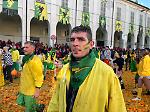
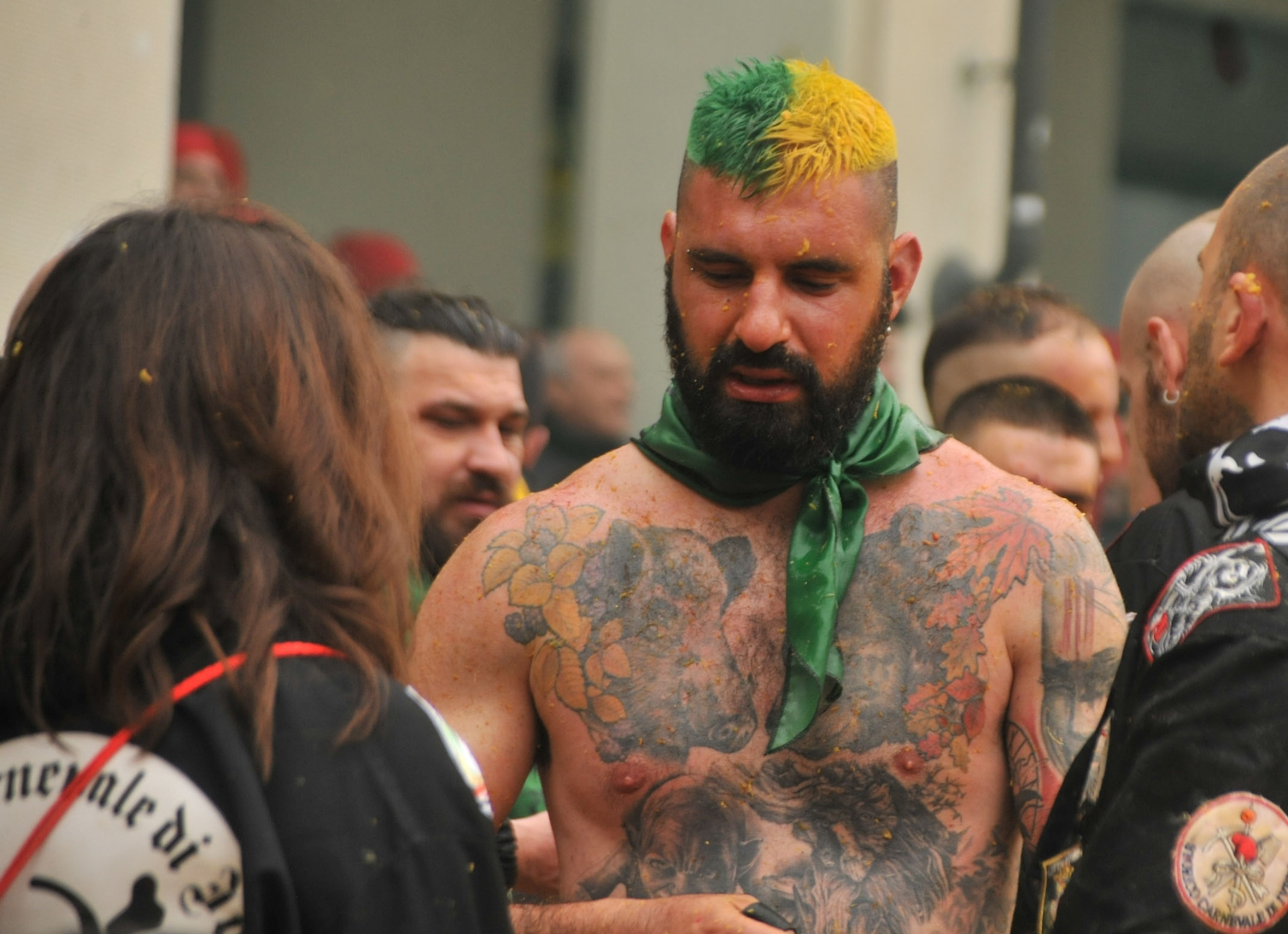
In un quartiere conosciuto come il Borghetto, dentro ad una piccola piazza, una squadra chiamata i Tuchini mangia pasta in scodelle compostabili. Tutti indossano una casacca verde allacciata davanti. Sopra di loro sventola una pubblicità: "Nel cuore della battaglia, non siamo mai soli".
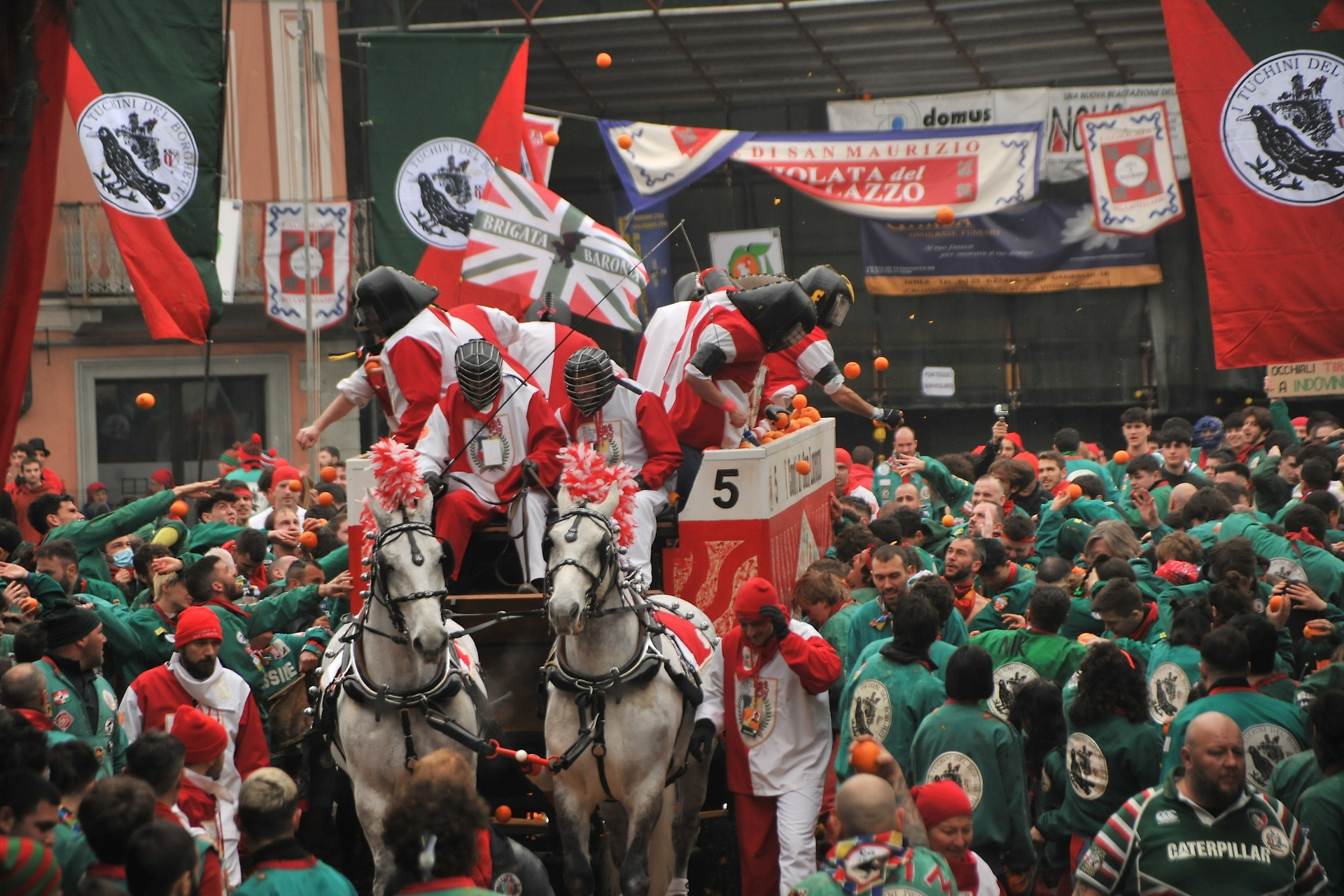
Ecco cosa è successo dopo. Ad un certo punto l'atmosfera a Borghetto si contrae come un pugno. All'angolo, il prima carro da getto si avvicina, sbattendo sul ponte di ciottoli che collega il quartiere al resto della città; si può sentire il rumore delle sue ruote sulla pietra, le campane sui finimenti dei cavalli tintinnano follemente.
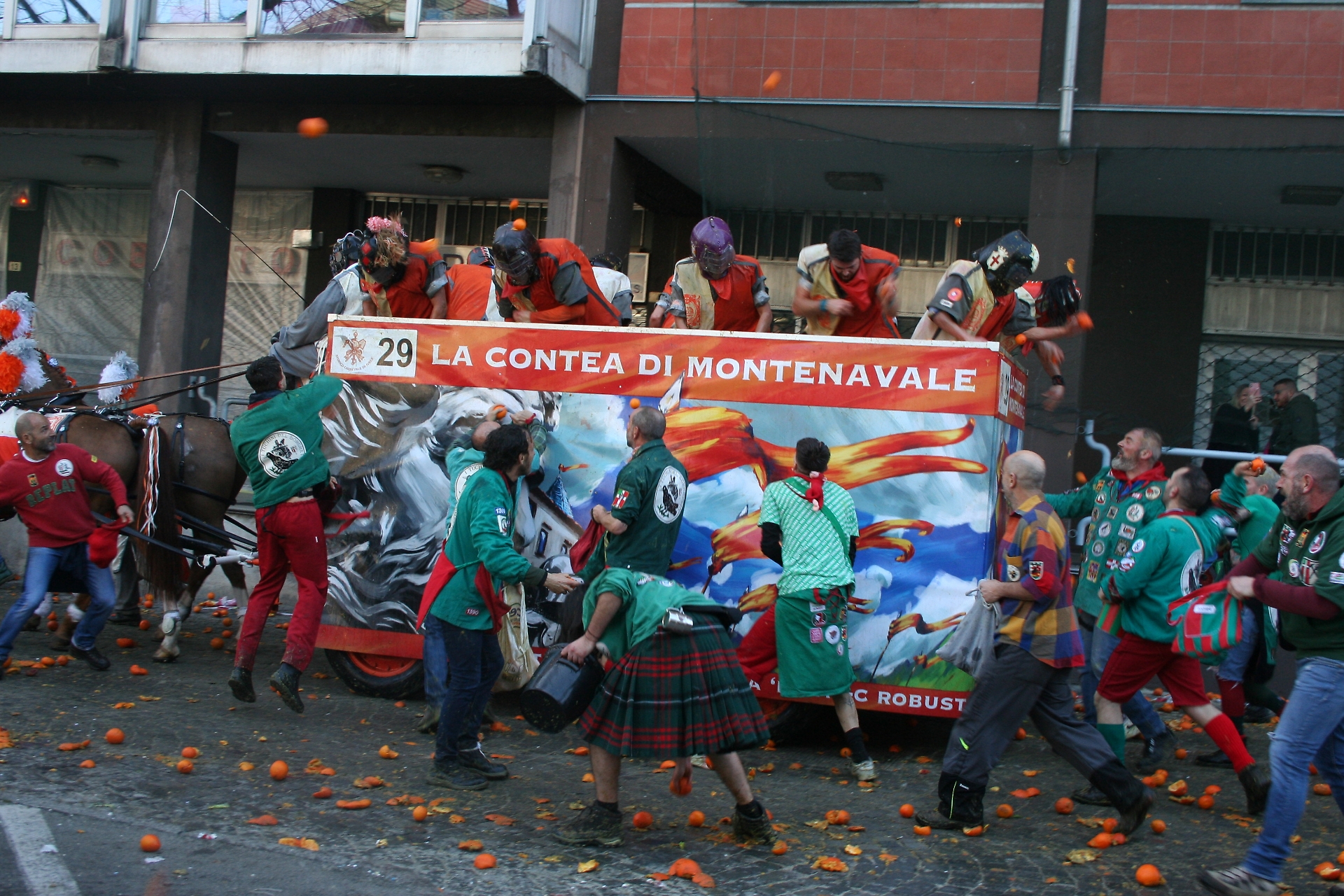
Quando il carro appare iniziano le urla. Gran parte della folla si precipita ai suoi fianchi. All'interno circa mezza dozzina di persone vestite da soldati medievali con la testa e il volto celato da inquietanti elmi di cuoio adornati con trecce. Stanno già lanciando arance senza pietà con entrambe le mani, con quegli spessi avambracci che pompano come pistoni, con quei pugni vuoti che si ricaricano dalle ciotole posizionate sui fianchi, mentre altri pugni sparano.
Lanciano arance meccanicamente. Lanciano dritto in basso, punendo le persone solo a due piedi sotto di loro - che, a loro volta, lanciano in continuazione verso l'alto. Le arance spruzzano nell'aria in tutte le direzioni come segatura, come scintille.
Il carro si ferma completamente al centro della piazza. La battaglia raggiunge un'alta intensità. Le arance schizzano dalle teste dei soldati e rotolano via dalle loro spalle in fogli. (La scena è così caotica che una volta, dieci anni fa, un lanciatore in una delle carrozze ebbe un attacco di cuore, ma nessuno notò il suo corpo senza vita finché la carrozza non finì il giro). Quando il carro riprende a muoversi, uscendo dalla piazza, gli irriducibili l'inseguono. Gli urlano contro con in bocca un misto di saliva e polpa. Nella calma che segue, la gente corre a raccogliere le arance dal suolo, quelle che sembrano sufficientemente integre per essere rilanciate. Poi arriva il carro successivo, e tutto ciò che era appena accaduto accadde di nuovo.
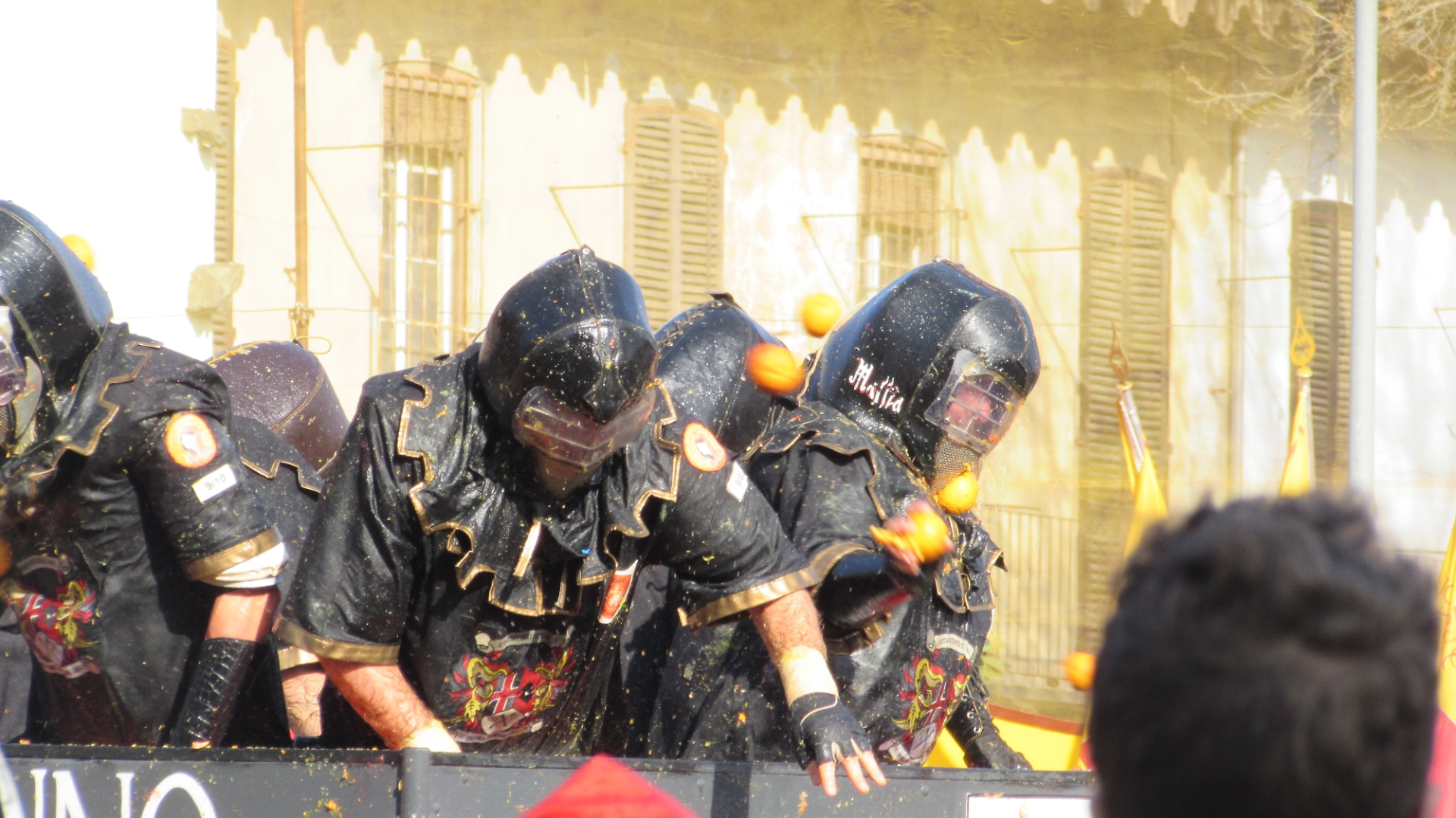
Ho avuto l'opportunità di partecipare alla battaglia in quel primo pomeriggio, anche se non mi erano state date istruzioni o suggerimenti. Di solito, gli aranceri devono registrarsi in anticipo e pagare una tassa di circa 120 euro, ma qualcuno dalla Fondazione del Carnevale Storico di Ivrea, che organizza l'evento, mi ha semplicemente regalato una maglia dei Tuchini enormemente grande e mi ha augurato buona fortuna. Ho preso posizione lanciando un'arancia da lunga distanza, sentendomi eccitato quando la mia prima arancia ha colpito il casco di un soldato e si è liquefatta spettacolarmente.
Quello che non avevo capito, però, è che molte persone stavano lanciando arance alle carrozze dalle stesse distanze - e da tutte le direzioni. Gettate da questo plotone di fuoco circolare volavano sopra la carrozza e sfrecciavano dritte verso le persone sul lato opposto: colpendo spalle, avambracci, tempie, bocche. Qualche secondo dopo il primo scontro, ne ho presa una in testa. Qualche minuto dopo, una donna mi è passata davanti, mentre gridava a un compagno che era stata colpita in un occhio. Ho guardato giù per annotare quel piccolo momento nel mio taccuino: un errore catastrofico. Non ho visto arrivare un arancia, che mi ha colpito proprio nel punto peggiore possibile. Piegato in due, barcollando e gemendo, ansimando e in preda al panico, ho temuto che potesse essere grave. Ho immaginato di dover spiegare l'infortunio a un urologo o, peggio ancora, a un chirurgo ricostruttivo specializzato in parti intime. Ci sono volute molte ore perché mi sentissi di nuovo bene.
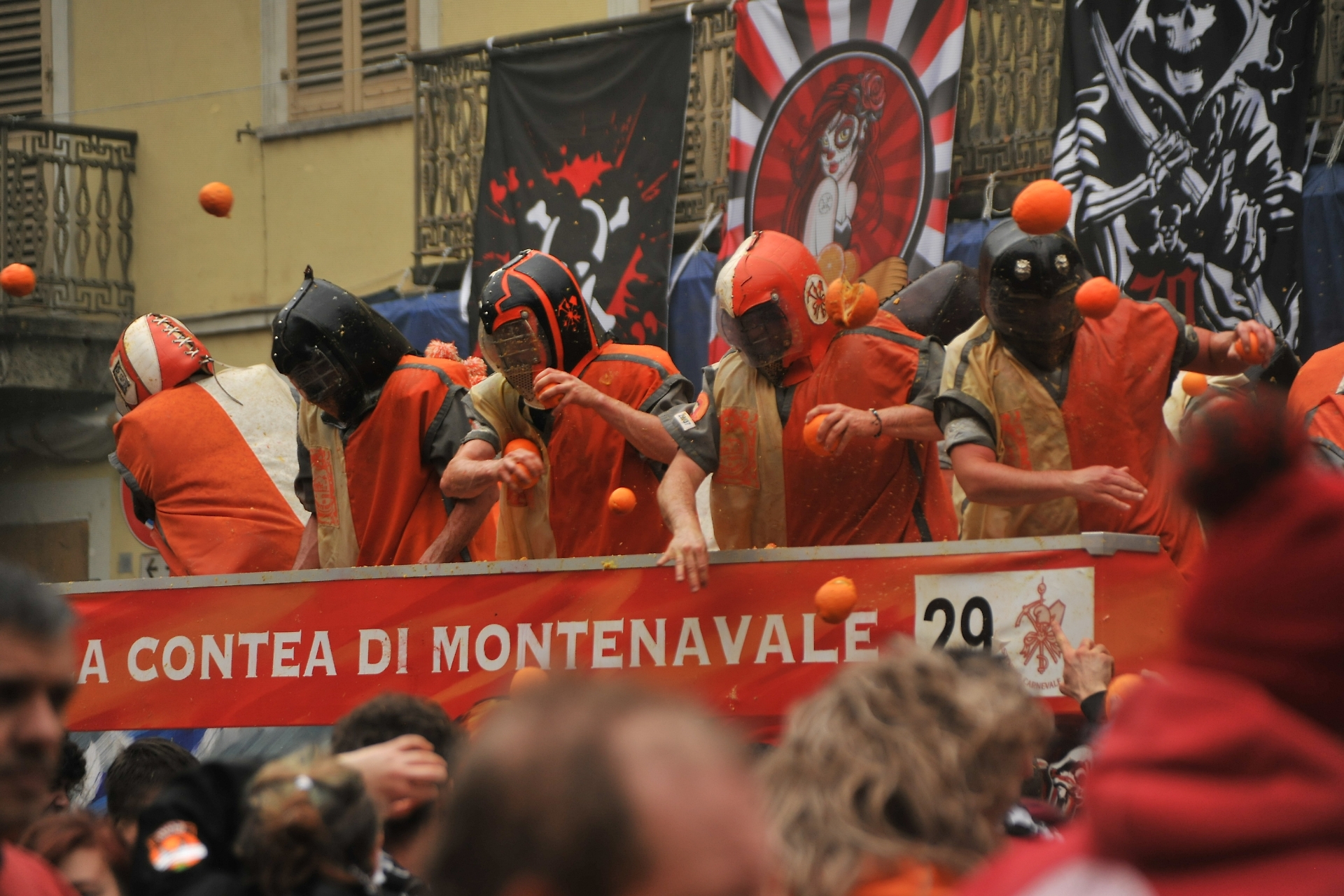
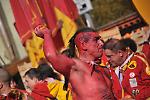
Da quel momento in poi, mi sono concentrato sull'osservazione e sull'evitarle. Nei tre giorni successivi, ho visto aranceri truccati come demoni, dipinti sul corpo, e uno con un bersaglio disegnato sulla testa rasata con le parole "Lancialo qui".
Ho visto una donna adulta nascondersi dietro la madre molto più piccola e anziana, entrambe ridendo mentre le arance cadevano dal cielo, e un uomo magro dal volto impassibile camminare mentre il carro si avvicinava con un cartello di cartone che diceva: "Mio padre è il primo nel carro. Uccidetelo".
Ho visto persone che arrotolavano sigarette con noncuranza a pochi passi dal fuoco incrociato. Un gruppo di giovani malconci che camminavano braccio nella braccio, imbevuti di succo, cantando "When the Saints Go Marching In" in inglese imperfetto ma esuberante. Ho assistito a diversi cosiddetti "battesimi", in cui un novellino, o un arancere percepito come debole, si inginocchia a terra mentre un cerchio stretto dei suoi compagni di squadra gli lancia arance mature in faccia da pochi centimetri di distanza.
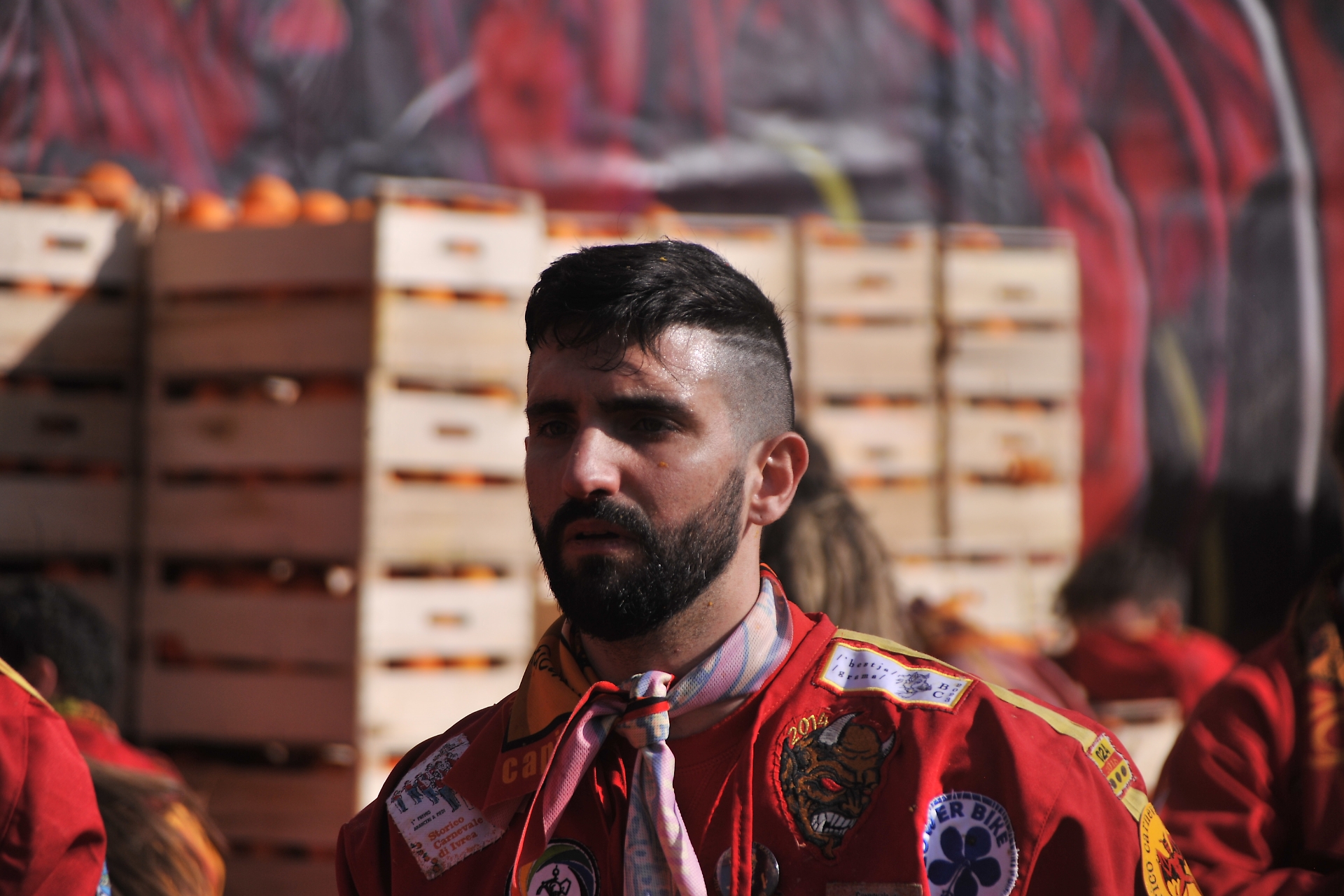
"È sangue?", chiede un giovane a un altro, esaminando il suo orecchio sinistro. "È sangue d'arancia", ha chiarito l'amico.
Ho però visto anche un sacco di sangue vero: crosticine sotto le narici, che catturano la luce del sole su un labbro scuro e gonfio. E di tanto in tanto, ogni volta che i lanciatori a bordo dei carri momentaneamente rimanevano senza arance, li ho visti, uno per uno, alzare i propri palmi vuoti, togliersi i caschi di cuoio e fare un magnifico gesto di applauso per gli aranceri a piedi - che, altrettanto cortesemente, restituivano l'applauso. Ci sono molte cose che ho trovato preoccupanti nella Battaglia delle Arance o che mi hanno fatto indietreggiare. Ma questo mi ha commosso ogni volta: tutti lanciano e vengono bombardati, ma lo fanno per divertirsi.
Detto questo, anche pochi minuti dopo quella prima schermaglia al Borghetto, non sono davvero riuscito a capire come tutti potessero continuare per altre tre ore, poi farlo di nuovo per altri due giorni. Le emozioni scatenate, l'effusione di ferocia mescolata a gioia, sembrano insostenibili - un'emozione una volta nella vita. Il terreno coperto da una poltiglia giallo elettrico. Il succo che cola da tutte le parti. La miscela che si solidifica per tre o quattro centimetri e ricopre tutte le piazze, con cumuli di arance su tutte le strade adiacenti. Una melma sufficiente a fare indossare gli stivali, a far chiudere un distretto scolastico se le arance fossero state neve.
E la melma diventa grigia, poi marrone, mentre altre arance più fresche continuano ad esplodere sulle fronti, sui visi, sulle guance e sui petti. In ogni momento, si possono vedere pezzi luminosi e riconoscibili di agrumi schiacciati in superficie. Sembra vomito. Sembra che la città stessa abbia vomitato. E da qualche parte, sicuramente, ci sono anche cumuli di letame dei cavalli, che di tanto in tanto spalancano la bocca per fare la cacca.
Questa è la melma che la società della nettezza urbana avrebbe portato via per tre serate di seguito.
Impossibile pulire tutto e molto resta compresso tra i ciottoli, uno strato incolore sulla superficie della città che la rende scivolosa. Le persone anziane, le madri con bambini legati al petto camminano con cautela senza lamentarsi. Altri prendono la rincorsa, si girano di lato e si godono il "viaggio".
Durante gli ultimi momenti della battaglia, un pomeriggio, ho visto un uomo di mezza età attraversare un angolo della piazza più grande della città tenendo in mano un bicchiere di vino rosso - un bicchiere vero e proprio. Ha appena bevuto un sorso quando, improvvisamente, i suoi piedi han cominciato a slittare all'esterno e si è schiantato a terra rivolto nella direzione sbagliata non potendo vedere la carrozza girare l'angolo e avvicinarsi proprio dietro di lui. Un uomo più giovane della squadra degli arancieri della Morte, con l'uniforme nera fradicia, la testa coperta da una confusione di capelli tinti di colori vivaci, s'è messo a correre , ha preso l'uomo per il braccio e lo ha trascinato fuori dal percorso del carro proprio all'ultimo secondo, evitando così che venisse investito dai cavalli.
L'uomo era scivolato senza attrito, come una pallina d'aria-hockey. Alzandosi in piedi, ha esaminato il bicchiere e se lo è ritrovato ancora quasi pieno. Era riuscito a tenerlo sollevato per tutto il tempo.
Ma perché? Perché le arance? Perché lanciare arance? Perché?
Circa otto secoli fa, Ivrea era governata da un despota, il marchese Ranieri di Biandrate. Un marchese spregevole, tirchio e crudele che quando una donna si sposava passava con lei la prima notte di nozze e la violentava. Una notte, tuttavia, secondo una mescolanza di storia e leggenda, la figlia di un mugnaio di nome Violetta riuscì a respingerlo. In breve tempo, apparve alla finestra del castello del tiranno tenendo in mano la sua testa decapitata. Contemporaneamente esplode la rivolta esplose. La devianza di Violetta incitò il popolo a bruciare il palazzo fino alle fondamenta e se ne liberarono. Da qui in avanti comincia la battaglia delle arance per tre giorni di fila.
In un certo senso sto saltando oltre 30 generazioni circa di storia locale in cui la tradizione si è complicata ed evoluta, prima di assumere la sua forma attuale negli anni successivi alla Seconda guerra mondiale. Inizialmente, nel Medioevo, la gente di Ivrea si gettava dei fagioli l'uno contro l'altro. Così è stato fino alla metà del XIX secolo quando han cominciato con le arance, assimilando un'altra tradizione locale in cui le ragazze sui balconi lanciavano arance ai ragazzi che piacevano loro.
Ma qualsiasi sia il cibo usato, l'idea è sempre stata quella di commemorare contemporaneamente la rivolta di Ivrea e celebrare la libertà che essa ha portato; i guerrieri robusti sui carri sono sostituti dell'esercito feudale del marchese, mentre gli arancieri a piedi, che li scacciano dalle piazze di volta in volta, rappresentano la popolazione in rivolta. Ad un certo punto, la tradizione si è fusa alla celebrazione tradizionale del Carnevale, che permette una simile libertà e baldoria nei giorni che precedono la Quaresima. Quindi, per riassumere: è un gioco di ruolo dal vivo. È una rievocazione storica. È il Mardi Gras tenuto a Colonial Williamsburg con ferite alla testa e frutta.
In realtà, il lancio di arance è solo il rituale più appariscente in una serie di tradizioni accessorie del Carnevale. Tutto il programma inizia molte settimane prima, con una parata il 6 gennaio, per poi procedere attraverso un rito prescritto con cura, come la riunione di 10 bambini convocati il "Sabato prima della terzultima domenica prima del Carnevale". Ho faticato a seguire la complessità da Dungeons and Dragons di tutte le cose che accadevano mentre ero in città: gli 11 diversi banchetti di fagioli; una cerimonia in cui una coppia appena sposata in ogni quartiere di Ivrea scava un buco; i pali di 30 piedi coperti di erica secca e ginepro che vengono posizionati al centro di alcune piazze e accesi in spaventose colonne di fuoco. ("Non spieghi il Carnevale", mi ha detto una donna. "Lo vivi."). Sapevo solo, ogni mattina, che avrei dovuto mettermi il berretto frigio - un lungo cappello rosso che gli spettatori devono indossare in ogni momento durante il Carnevale mentre sono all'interno delle mura della città. Il berretto frigio ti identifica come sostenitore dell'autodeterminazione e della libertà. Se cammini senza il berretto frigio, gli arancieri possono attaccare. "Sarai preso di mira", ho sentito uno degli organizzatori del Carnevale avvertire un reporter che era arrivato con un elegante cerchietto rosso invece del cappello.
Il risultato di tutto ciò è un insieme di personaggi estratti casualmente da altri periodi della storia, che sfilano in costumi antiquati. Ogni anno, diverse persone di alto rango ricevono l'onore di interpretare un ruolo particolare. Questi includono il Generale, a cui il sindaco di Ivrea conferisce il controllo simbolico sulla città per la durata del Carnevale, e il Sostituto del Gran Cancelliere, che registra tutto ciò che avviene, minuziosamente in un un libro dei verbali. (Questi dignitari aiutano anche a finanziare le festività in cambio della loro nomina, alcuni di loro staccano assegni fino a 30.000 euro.).
La star indiscussa del Carnevale, tuttavia, è la Vezzosa Mugnaia, l'incarnazione di Violetta, che ha scatenato la rivolta originale. La Mugnaia trascorre gran parte del Carnevale attraversando la città su un carro dorato, indossando un abito bianco e una fascia verde, gettando fiori e caramelle alla folla. Ovunque vada, la lotta si ferma e centinaia di persone urlano "Viva La Mugnaia" e perdono la testa.
L'identità della Mugnaia di ogni anno viene tenuta segreta fino alla notte prima della prima battaglia d'arance. Poco dopo il mio arrivo in città, ho visto dalla piazza centrale affollata di Ivrea un gruppo di uomini con indosso cappotti borchiati e parrucche bianche che la presentavano dal balcone del municipio urlando il nome Elena Bergamini in Bardus, dopodiché una donna dai capelli scuri è apparsa in una finestra adiacente, agitando entrambe le braccia febbrilmente avanti e indietro. (Il saluto aveva un'intensità bizzarra. Sembrava che stesse cercando di fermare un aereo che si avvicina con imprudenza al gate sbagliato.)
A quel punto la folla si è esaltata. Il suo nome non sarebbe stato familiare alla maggior parte di coloro che la acclamavano, ma poco importa. Bergamini in Bardus è una ex clarinettista e madre di due figli che lavora in un comune vicino, ma ora era la loro Mugnaia e questo era sufficiente.
Alla fine, la Mugnaia è salita sul suo carro ed è uscita dalla piazza. Tutti l'hanno inseguita. Improvvisamente ha preso vita una sfilata, con pifferi e tamburi e il Generale nel suo abbigliamento militare, la mano in un saluto fermissimo, come se fosse un dipinto ad olio di sé stesso. Ci sono brigate di soldati con moschetti e lance; le squadre di aranceri che ballano e cantano sotto le proprie bandiere e onde di ordinari ed euforici eporediesi e turisti, tra cui - da qualche parte nella folla bloccata di corpi - io. Il passo della processione è glaciale. La claustrofobia intensa. Ma sono l'unico che sembra infastidito. Cerco di uscire dalla sfilata e di girarci intorno, solo per rimanerci di nuovo bloccato.
Questo è un tema. Sfilate di varie dimensioni e complessità serpeggiano ovunque per le strade di Ivrea durante il Carnevale, e mentre mi affretto a raggiungere la fine di qualche cerimonia o seguire i vari appuntamenti in città, vengo bloccato o assorbito da loro ancora e ancora. Le sfilate attraversano il mio cammino in modo perpendicolare. Intasano la strada davanti a me. Una volta, sono rimasto intrappolato dietro una sfilata solo per vederla improvvisamente girarsi e venirmi incontro. E' una cosa strana che continua a succedere a una persona durante una celebrazione della libertà, ma non riesco semplicemente ad eludere le sfilate; sembrano sempre più grandi, più lunghe e più lente ogni volta che ci provo. Un'altra volta - giuro - una sfilata si è rigenerata magicamente davanti a me due volte, come se fosse un nastro di Möbius. Una sera mentre stavo avendo una piacevole conversazione nell'atrio del municipio, non mi sono accorto dei pifferi e dei soldati in uniforme che si stavano radunando sulla scalinata anteriore alle mie spalle e sono rimasto intrappolato all'interno.
Quel suono dei pifferi. Sembra ssurdo, come una metafora, come una storia di Kafka: un umile impiegato in una città europea che, ogni volta che lascia il suo appartamento, è circondato e ostacolato da sfilate cerimoniali. Un'unica cosa era chiara. Io non ero il protagonista. Non ero niente. La mia autonomia e i miei desideri erano assorbiti da una tradizione che appartiene ad altri.
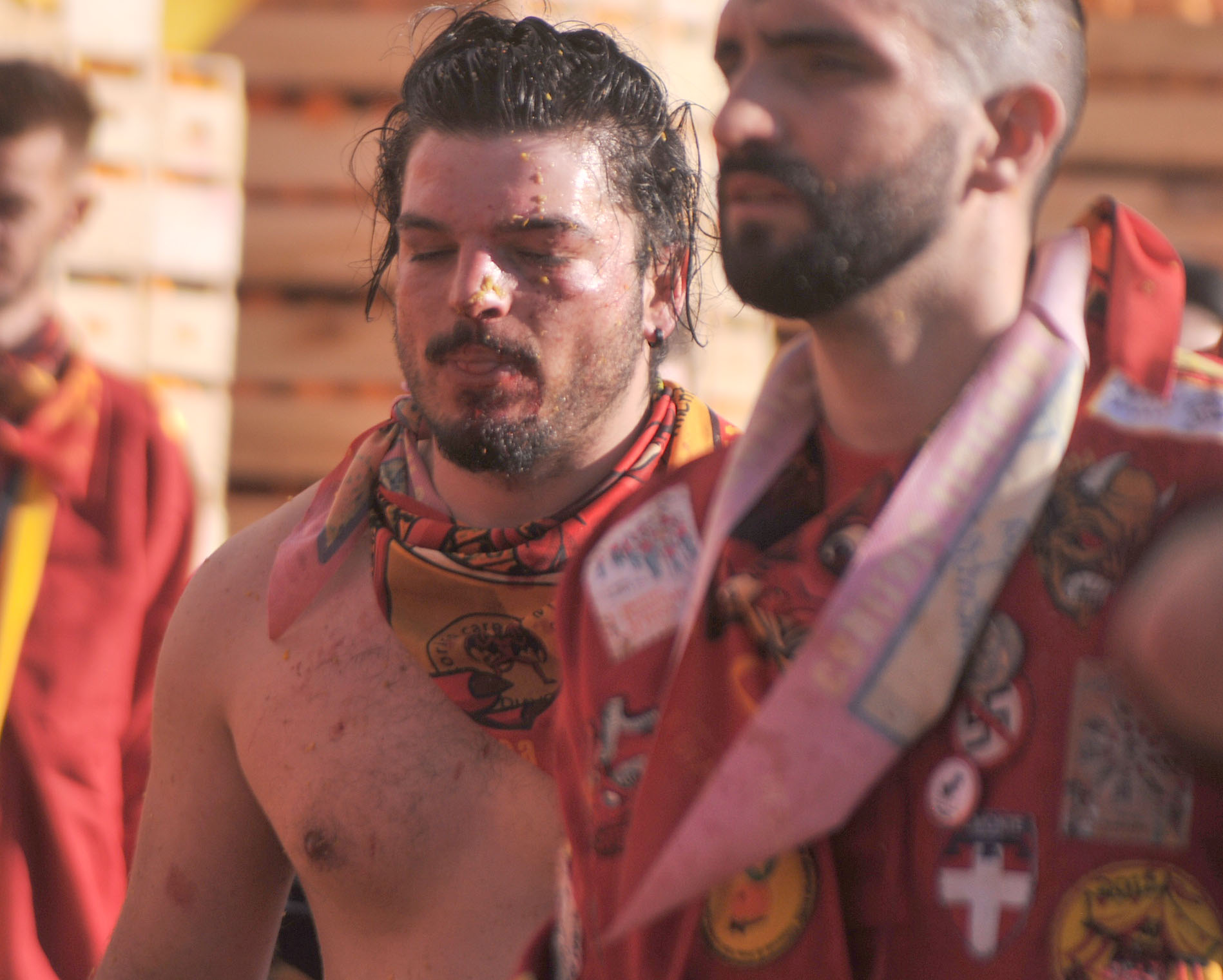
Ogni mattina durante la Battaglia delle Arance, nuovi occhi neri sbocciano in tutta la città. Sotto altri occhi, si alzano enormi cuscini di carne violacea. E poi ci sono gli occhi sanguinanti.
Segni di valore a Ivrea. Secondo diversi capi di squadra con cui ho parlato, la gente vuole farsi male. Infatti, periodicamente si nota qualche aranciere estremamente motivato, immobile dietro una carrozza con il volto rivolto verso i lanciatori, per invitare un colpo diretto, come un uomo che fosse stato confinato in casa per anni, ipnotizzato dal calore del sole. E tra le numerose toppe cucite sulle magliette delle persone, ce n'è una una con la stessa figura utilizzata per indicare i generi sui cartelli dei bagni, alzando un braccio per proteggere il volto.
Al momento dell'ultimo lancio di arance, 469 persone avrebbero cercato assistenza medica dai paramedici sul posto, anche se guardandosi intorno, si aveva la sensazione che queste non fossero necessariamente le persone più gravemente ferite, ma solo i lamentosi. Eppure, durante la Battaglia delle Arance, quasi mai ho visto una qualche espressione di dolore. Solo una volta: un giovane ragazzo che correndo si è gettato tra le braccia della madre piangendo, dopo essere stato colpito nell'occhio. (Considerate non solo il dolore dell'impatto ma anche il bruciore del succo). La mia teoria è che la gioia sia un potente analgesico. I recettori del dolore di tutti erano cortocircuitati dalla felicità. Anche tra coloro ai margini della battaglia, anche tra gli spettatori, un'accettazione impassibile del pandemonio irreale. C'è la giovane donna colpita improvvisamente da schegge di succo, che casualmente si asciuga la guancia in mezzo a una conversazione; l'uomo e la donna che si coccolano teneramente con le spalle rivolte a una carrozza; i genitori senza timore per i propri figli; i bambini senza timore per sé stessi.
Quattro giorni trascorsi ad Ivrea non mi hanno insensibilizzato alla stranezza di tutto ciò. Per me, è inconcepibile, alienante a volte. Anche molti italiani fuori da Ivrea trovano la Battaglia delle Arance imbarazzante o incivile. Ogni anno è un rifiorire di critiche. C'è preoccupazione per il benessere dei cavalli che trainano le carrozze, disgusto per tutti gli sprechi di cibo. Ho letto dei passi compiuti per affrontare questi problemi - ad esempio, ora esiste un programma per trasformare le arance usate in compost e biocarburante - ma la Fondazione dello storico Carnevale non si vanta più di tanto di questi progressi come si farebbe in America.
Ad un certo punto, Stefano Ampollini, responsabile delle relazioni pubbliche per la Fondazione e appassionato aranciere fin dall'infanzia, mi dice: "Quello che diciamo ad Ivrea è che l'unica arancia che viene sprecata è quella che non gettiamo". E quando gli dissi che avevo visto quel bambino colpito nell'occhio e che aveva cominciato a piangere, Ampollini risponde: "Sì?" ed è passato oltre.
I turisti continuano ad arrivare - per lo più italiani, relativamente pochi dall'estero - e non sono certo malvisti. Ma c'è poco materiale o segnali per orientarli, e pochi souvenir da comprare. A godere di questi quattro giorni sono soprattutto gli eporediesi, sembra quasi che chiunque altro sia un po' di intralcio. Intrattenere gli estranei non è lo scopo, né accontentare i critici o manipolare l'immagine di giovani che si fanno male. Lo scopo è più semplice. E' un gioco che gli eporediesi amano fare per il proprio piacere e soprattutto tra loro.
Una cosa mi ha colpito più di altre. L'ultima processione, un corteo funebre notturno per piangere la fine del Carnevale. Pensavo sinceramente di essere riuscito a evitarla ma prima che capissi cosa stesse succedendo, sono stato spinto sul lato della strada con una folla di altri spettatori - un ammasso di giacche imbottite, alcune macchiate di polpa secca.
L'atmosfera è solenne. L'estetica essenziale. Questa volta non ci sono cavalli, né bande di pifferi o tamburi, solo il triste suono disarmonico di alcuni flauti di legno mentre il Generale e il suo seguito si avvicinano a piedi. La folla non emette alcun suono. La loro reverenza sembra totale. Quando suona un telefono, viene fatto tacere.
Un fragile equilibrio tra serietà e non serietà del Carnevale, tra l'aspetto folle della cosa e il suo significato profondo. Ho amato la Battaglia delle Arance per avere reso possibile tutto questo. E' stata la cosa più brutta e bella che abbia mai visto.
It looked as if a war was coming. It was. One Sunday last month, in a northern Italian town called Ivrea, the facades of historic buildings were covered with plastic sheeting and nets. Storefront windows had been fortified with plywood and tarps. And in several different piazzas, hundreds of wooden crates had appeared, walls of them stacked eight feet high and even farther across. The crates looked like barricades but were actually arms depots. Inside them were oranges. Oranges, the fruit.
Over the next three days, 8,000 people in Ivrea would throw 900 tons of oranges at one another, one orange at a time, while tens of thousands of other people watched. They would throw the oranges very hard, very viciously, often while screaming profanities at their targets or yowling like Braveheart, and they would throw the oranges for hours, until their eyebrows were matted with pulp and their shirts soaked through. But they would also keep smiling as they threw the oranges, embracing and joking and cheering one another on, exhibiting with their total beings a deranged-seeming but euphoric sense of abandon and belonging — a freedom that was easy to envy but difficult to understand.
The Battle of the Oranges is an annual tradition in Ivrea and part of a larger celebration described by its organizers as “the most ancient historical Carnival in Italy.” Three years ago, things kicked off as they always do, with a few initial hours of hurling and splattering, but then the rest of the battle was abruptly called off. Covid had surfaced in the region, and after an emergency meeting of government officials that afternoon, the decision was made to shut the festival down. Several people in Ivrea told me that, as two more pandemic years passed in which no oranges could be thrown, they grew concerned that something bad would happen in the community — that without this catharsis, a certain pent-up, sinister energy would explode. But it didn’t. They’d made it. And now, the scent of stockpiled citrus was mixing with the musk of centuries-old masonry. The arancieri, or orange throwers, were standing by.
Ivrea’s arancieri are organized into nine teams, each with a different flag, logo, captain and uniform. They have names like the Devils, the Mercenaries, the Black Panthers, Death. As 2 p.m. approached, the arancieri crammed shoulder to shoulder in their assigned piazzas, each waiting to do battle with 47 brigades of other orange throwers who would come marauding through the city in horse-drawn carts. Many had been partying until 2 or 3 a.m. the night before, and many were drinking that morning too; the city was awash in disposable cups of mulled wine and Bombardino, a boozy, eggnoggy concoction, served warm. They were predominately men, especially young men, though there were many women, too. There were also older people who’d been participating in the Battle of the Oranges since they were the age of those young people. Some had taken those young people to their first battles in strollers, 20-odd years ago. (One woman showed me a photo with pride.) In a neighborhood known as the Borghetto, a team called the Tuchini polished off compostable bowls of pasta in their small piazza, waiting in their green jerseys with poofy sleeves and lace-up fronts. Over their heads hung a banner: “In the heart of the battle, we are never alone.”
Here’s what happened next: The atmosphere in the Borghetto contracted like a fist. Around the corner, the first carriage approached, barreling across the cobblestone bridge that connects the neighborhood to the rest of the city; you could hear the low rumble of its wheels on stone, the bells on the horses’ bridles jingling madly. As soon as the carriage appeared, the fusillade and the screaming started simultaneously. Much of the crowd rushed to its flanks. Inside the carriage, about half a dozen people dressed as medieval soldiers, their heads and faces disguised by creepy leather helmets adorned with braids, were already sidearming oranges mercilessly with both hands, their thick forearms pumping like pistons, their emptied fists reloading from the troughs at their waists while the opposite fists discharged. They chucked oranges in a kind of balletic flow-state, the brutal apparatuses of their torsos swiveling efficiently but hard. They threw straight down, punishing the people only two feet below — who, in turn, threw relentlessly upward at them. Oranges sprayed through the air omnidirectionally like sawdust, like sparks.
The carriage came to a full stop at the center of the square. The battle reached a higher intensity. Oranges splattered off the soldiers’ heads and rolled off their backs in sheets. (The scene is so chaotic that once, a decade ago, a thrower in one of the carriages had a heart attack, but no one noticed his body slumped there until they were getting out of the carriage.) When the carriage started moving again, exiting the piazza, the die-hards gave chase. They yelled at it through a froth of spittle and pith. In the calm that followed, people scampered around to claim oranges off the ground that looked intact enough to be relaunched. Then the next carriage arrived, and everything that just happened happened again.
I had the opportunity to participate that first afternoon, though I’d been given zero instructions or tips. Ordinarily, arancieri must register with a team weeks in advance and pay the roughly 120-euro fee, but someone from the Historic Carnival of Ivrea Foundation, which organizes the event, had simply gifted me an emasculatingly oversize Tuchini jersey and wished me luck. I took up a position on the periphery, tossing the occasional orange from long range, feeling giddy when my first one thwacked into a soldier’s helmet and liquefied spectacularly. What I hadn’t understood, though, is that many people were winging oranges at the carriages from similar distances — and from all directions. Tracers from this circular firing squad were sailing over the carriage or streaking past the bodies on board and whizzing straight at the people on the opposite side: catching shoulders, forearms, temples, mouths. Seconds into the first skirmish, I took one off the crown of my head. A few minutes later, a woman crossed in front of me, hollering to a companion that she’d been struck in the eye. I looked down to record that little moment in my notebook: a catastrophic mistake. I never saw the orange coming, and it struck in precisely the worst possible spot. Doubled over, staggering and groaning, panting and panicked, I worried it might be serious — life-altering, even. I pictured having to explain the injury to a urologist or, worse, a reconstructive surgeon specializing in intimate parts. It took many hours for my insides to feel right.
From then on, I concentrated on watching and dodging. Over the next three days, I’d see arancieri in demonic face paint, in body paint, and one with a bull’s-eye scrawled on his bald head with the words “Throw it here.” I’d watch a grown woman duck for cover behind her much smaller, much older mother, both giggling as the oranges rained down, and a slender, deadpan-faced guy walk through a piazza as the next carriage approached with a cardboard sign that said: “My father is the first one in the carriage. Kill him.”
I’d watch people nonchalantly rolling cigarettes just steps from the crossfire. A group of battered young people walking arm in arm, saturated with juice, singing “When the Saints Go Marching In” in imperfect but exuberant English. I’d witness several so-called “baptisms,” in which a first-timer, or an arancieri otherwise perceived to be weak, kneels on the ground while a tight circle of his teammates whips overripe oranges at his face from inches away. “Is that blood?” I’d hear one young man ask another, examining his left ear. “It’s blood orange,” the friend clarified. Though I’d see plenty of actual blood too: crusting under nostrils, catching the sunlight on a dark, puffy lip. And from time to time, whenever the throwers aboard the carriages momentarily ran out of oranges, I’d watch them, one by one, raise their empty palms, remove their leather helmets and make a magnificent gesture of clapping for the arancieri on foot — who, just as graciously, returned their applause. There was a lot I found alarming about the Battle of the Oranges or that made me recoil. But this touched me every time: Everyone throwing and being thrown at, working together to have a good time.
That said, even minutes into that first skirmish in the Borghetto, I truly couldn’t imagine how everyone could keep it up for three more hours, then do it all again for two more days. The emotions being unleashed, the outpouring of ferocity mixed with joy, seemed unsustainable — a once-in-a-lifetime rush. Besides, the ground was already covered in an electric yellow mash. The juice bled out. The slurry congealed. Soon there would be three to four inches of it carpeting Ivrea’s piazzas end to end, mounds and streaks all over the adjoining streets. It was enough to suction your boots in place if you stood in it too long, enough to close a school district, if the oranges were snow. And when you put your foot down into it, it burped upward like a simmering marinara and splotched the ankles of your pants.
This material turned gray, then brown, in the afternoon air, all while other, fresher oranges kept exploding off foreheads, faces, cheeks and chests and touching down. At any given moment, you’d see bright, recognizable chunks of citrus smushed in at the surface of the mess. It looked exactly like vomit. It looked as if the city itself had thrown up. And somewhere in there, surely, were also pockets of manure from the horses, which, held stationary at the center of the battles, could be seen baring their teeth, then taking a crap.
This was the muck that Ivrea’s street-cleaning machinery would be left to confront, three evenings straight. And though the heroic little brush-trucks succeeded in sucking up the bulk of it, they couldn’t clean everything. They compressed the remnants into the channels between the cobblestones and left a colorless scum coating the surface of the town. It was superslick. Many people — delicate-looking older people, mothers with infants strapped to their chests — tread carefully without complaint. Others took running starts, turned sideways and enjoyed the ride.
During the final moments of the battle one afternoon, I watched a middle-aged man cross a corner of the town’s largest piazza holding a glass of red wine — an actual glass. He’d just taken a sip when, suddenly, his feet skidded outward and he crashed on his side. He landed facing the wrong direction; he did not see the carriage turn the corner and bear down right behind him. A younger man from the arancieri team Death, his black uniform drenched, his head topped with a tangle of brightly dyed hair, dashed off the sidewalk, grabbed the fallen man by the arm and dragged him out of the way of the horses at the very last second.
The man glided frictionlessly, hydroplaning like an air-hockey puck. Finally rising to his feet, he examined his glass and found it mostly full. He’d managed to hold it aloft the entire time. There were hardly any streaks up the sides.
But why? Why oranges? Why throw oranges? Why?
Eight centuries ago, more or less, present-day Ivrea was ruled by a despot, the Marquis Ranieri di Biandrate. The marquis was despicable, stingy and cruel. He customarily abducted peasant women on their wedding nights and raped them. One night, however — according to a mishmash of history and legend — a miller’s daughter named Violetta managed to fight him off. Before long, she appeared in the window of the tyrant’s castle by firelight, holding his decapitated head in one hand. A revolt ignited — instantly. Violetta’s defiance incited the populace to burn the palace to the ground, freeing themselves to do whatever they pleased. And what pleased them, apparently, was to hurl oranges at one another annually for three days straight.
Sort of. I’m skipping over 30-odd generations of local history in which the tradition complexified and evolved, before assuming its current form in the years after World War II. Initially, in the Middle Ages, the people of Ivrea threw beans at one another. It wasn’t until the mid-1800s that they first weaponized oranges, assimilating another, local tradition wherein girls on balconies tossed oranges at boys they liked. But whatever the foodstuff, the idea has always been to simultaneously commemorate Ivrea’s rebellion and celebrate the freedom it brought; the burly warriors on the carriages are stand-ins for the marquis’s feudal army, while the arancieri on foot, who rout them out of the piazzas again and again, represent the rampaging populace. At some point, the tradition was also fused to the traditional celebration of Carnival, which allows for similarly unrestrained raucousness and heavy drinking in the days leading up to Lent. So, to sum up: it’s live-action role-playing. It’s historical re-enactment. It’s Mardi Gras held at Colonial Williamsburg with head wounds and fruit.
In fact, the orange-throwing is only the most attention-grabbing ritual in a sprawl of ancillary Carnival traditions in Ivrea. The whole program begins many weeks earlier, with a ceremonial parade in early January, then proceeds through one fastidiously prescribed rite after another, such as a gathering of 10 children convened on “the Saturday before the third to last Sunday before Carnival.” I struggled to follow the Dungeons and Dragons-like complexity of it all, even the stuff happening while I was in town: the 11 separate bean feasts; a ceremony in which a recently married couple in each of Ivrea’s neighborhoods dig a hole; the 30-foot poles covered in dried heather and juniper that are placed at the center of certain piazzas and ignited into frightening pillars of flame. (“You don’t explain Carnival,” one woman told me. “You live it.”) I just knew, every morning, to put on my berretto frigio — a long, red stocking cap that spectators must wear at all times during Carnival while within Ivrea’s city walls. The berretto frigio identifies you as a supporter of self-determination and freedom. Walk around without a berretto frigio, and the arancieri may attack. “You will be targeted,” I heard one of Carnival’s organizers warn a reporter who’d arrived in a stylish red headband instead of the hat.
Presiding over all of this is a coterie of characters plucked haphazardly from other periods in Ivrea’s history, parading around in antiquarian costumes. Each year, different high-status local people are given the honor of playing a particular role. These include the General, who is granted symbolic control over the city for the duration of Carnival by Ivrea’s actual mayor, and the Assistant Grand Chancellor, who records the successful completion of each persnickety tradition in a large, fancy book. (These dignitaries also help fund the festivities in exchange for their appointments, with some of them cutting checks for as much as 30,000 euros.) The unquestioned star of Carnival, however, is the Vezzosa Mugnaia, or Charming Miller’s Daughter, an embodiment of Violetta, who sparked the original revolt. The Mugnaia spends much of Carnival crisscrossing the city in a golden chariot, wearing a white gown and green sash, heaving armfuls of candy and flowers overboard to the crowds. Everywhere she goes, the fighting stops and hundreds of people shriek, “Viva La Mugnaia” and basically lose their minds.
The identity of each year’s Mugnaia is kept secret until the night before the first orange battle. Shortly after arriving in town, I watched from Ivrea’s packed central piazza as a congress of men in brass-studded coats and white wigs introduced her from the balcony of the city hall. They shouted the name Elena Bergamini in Bardus, and a dark-haired woman appeared in an adjacent window, waving both arms feverishly back and forth. (As a greeting it had a bizarre intensity. She looked as if she were trying to stop an airplane taxiing recklessly toward the wrong gate.) The crowd turned rapturous. Her name would not have been familiar to most of those cheering in the piazza — Bergamini in Bardus is a former concert clarinetist and mother of two who works for a nearby municipality — but she was their Mugnaia now, and that was enough.
Eventually, the Mugnaia climbed into her chariot and exited the square. Everyone filed out behind her. Suddenly: a parade. There were drummers and fife players, screeching away on their wooden flutes, and the General in his military regalia, his hand held in a firm salute, as though he were an oil painting of himself. There were brigades of soldiers with muskets and spears; the arancieri teams, dancing and chanting beneath their towering flags; and waves of ordinary, elated Ivreans and outsiders, including — somewhere in the barely-moving logjam of bodies toward the back — me. The pace of the procession was glacial. The claustrophobia was intense. But I was the only one who seemed put out. I’d struggle to exit the parade and go around it, only to get stuck in the parade again.
This became a theme. Parades of various sizes and complexities snaked everywhere through Ivrea’s streets during Carnival, and as I hustled to catch the end of some ceremony or keep various appointments in town, I’d be blocked or absorbed by them again and again. Parades crossed my path perpendicularly. They clogged the road ahead. Once, I was trapped behind a parade only to have it suddenly turn around and come straight at me. It was an odd thing to keep happening to a person during a celebration of freedom, but I simply could not outfox the parades; they seemed to get bigger, longer and slower whenever I tried. Another time — I swear — a parade appeared to magically regenerate and pass in front of me twice, as though the parade were a Möbius strip. One night I was having a pleasant conversation in the lobby of city hall and didn’t notice the uniformed brass players and soldiers amassing on the front staircase behind me — forming a parade, trapping me inside.
Soon, I’d tense up at the sound of distant fifes. It felt preposterous, like a metaphor, like a Kafka story: a lowly office clerk in a European city who, every time he leaves his apartment, is encircled and thwarted by ceremonial parades. Except — this couldn’t have been clearer — I wasn’t the protagonist. I was nothing. My autonomy and desires were subsumed by a tradition that belonged to, and was beloved by, everyone else.
Every morning during the Battle of the Oranges, new black eyes bloomed all over town. Under other eyes, huge, empurpled cushions of flesh rose up. Still others were bloody where they should have been white.
These were signs of valor in Ivrea. According to several team leaders I spoke to, people wanted to get bruised. In fact, you’d periodically spot some gung-ho arancieri standing stock-still behind a carriage with his face raised toward the throwers to invite a direct hit, like a man who’d been confined indoors for years, hypnotized by the heat of the sun. And among the many patches I’d spot sewn onto people’s jerseys was one with the same figure used to indicate genders on bathroom doors, raising an arm to shield its face. A thick red line ran through the illustration: It wasn’t allowed.
By the time the last orange was thrown, 469 people would seek medical attention from the on-site paramedics, though looking around, you got the sense that these weren’t necessarily the most severely injured people, just the complainers. And yet, what I almost never saw during the Battle of the Oranges was any public expression of pain. Only once: a young boy running into his mother’s arms, wailing, after being tagged in the eye. (Consider not only the pain of the impact but the sting of the juice.) My theory was that jubilation was a powerful analgesic. Everyone’s pain receptors were short-circuited by delight. Even among those at the edges of the battle, even among the spectators, there was a dispassionate acceptance of the pandemonium that felt unreal. There was the young woman, struck suddenly by citrusy shrapnel, casually wiping down her cheek in the middle of a conversation; the man and woman snuggling tenderly with their backs turned to a carriage, her head taking shelter in the crook of his neck; the parents without fear for their children; the children without fear for themselves.
Four days in Ivrea hadn’t desensitized me to the unusualness of any of it. For me, it was unrelatable, alienating at times. Even many Italians outside Ivrea find the Battle of the Oranges embarrassing or uncivilized. Every year, criticisms arise. There is concern for the welfare of the horses pulling the carriages, disgust with all the wasted food. I’d read about steps taken to address these issues — there’s now a program to turn the spent oranges into compost and biofuel, for example — but the Historic Carnival of Ivrea Foundation did not brag about these advancements the way an American festival would. At one point, Stefano Ampollini, who runs public relations for the foundation and has been a fanatical arancieri himself since boyhood, told me, “What we say in Ivrea is that the only orange that’s wasted is the one we don’t throw.” And when I mentioned to him that I’d seen that one boy get hit in the eye and start crying, Ampollini said, “Yes?” and moved on.
Tourists kept arriving — still mostly other Italians; relatively few, it seemed, from abroad — and they definitely weren’t unwelcome. But there was little signage or material around to orient them, and shockingly few souvenirs for them to buy. Given the perilous environment, given how much locals needed those four days to provide an all-consuming torrent of pleasure, it seemed like anyone else was kind of in the way. Entertaining outsiders wasn’t the point, nor was appeasing critics or massaging the optics of young men hurting one another in the year 2023. It seemed to me that the point of the Carnival was exquisitely simple. It was a game Ivreans loved playing together, for its own sake and primarily among themselves.
This hit me most powerfully while stuck in one last parade. It was the final procession of the festival, a somber, late-night funeral march through the medieval city to mourn Carnival’s end. I genuinely thought I’d outsmarted this parade and beat it to its destination, but before I knew what was happening, I was herded onto the side of the street with a crush of other parade-watchers — a blob of puffy jackets, some of them blotched with dried pulp.
The mood was solemn. The aesthetic was spare. There were no horses this time, no brass bands or drums — just the sad, out-of-tune quavering of a few wooden flutes while the General and his entourage approached on foot. The crowd did not make a sound. Their reverence seemed total. When a phone rang, it was stifled. When a long rubbery fart sounded in the stillness, not a single person laughed.
A fragile equilibrium was being maintained, between the seriousness and unseriousness of Carnival, between how crazy the thing looked and how meaningful it felt. I loved the Battle of the Oranges for pulling that off. It was the ugliest beautiful thing I ever saw.

|
|
Edicola digitale
I più letti


Ultimi Video


LA VOCE DEL CANAVESE
Reg. Tribunale di Torino n. 57 del 22/05/2007. Direttore responsabile: Liborio La Mattina. Proprietà LA VOCE SOCIETA’ COOPERATIVA. P.IVA 09594480015. Redazione: via Torino, 47 – 10034 – Chivasso (To). Tel. 0115367550 Cell. 3474431187
La società percepisce i contributi di cui al decreto legislativo 15 maggio 2017, n. 70 e della Legge Regione Piemonte n. 18 del 25/06/2008. Indicazione resa ai sensi della lettera f) del comma 2 dell’articolo 5 del medesimo decreto legislativo
Testi e foto qui pubblicati sono proprietà de LA VOCE DEL CANAVESE tutti i diritti sono riservati. L’utilizzo dei testi e delle foto on line è, senza autorizzazione scritta, vietato (legge 633/1941).
LA VOCE DEL CANAVESE ha aderito tramite la File (Federazione Italiana Liberi Editori) allo IAP – Istituto dell’Autodisciplina Pubblicitaria, accettando il Codice di Autodisciplina della Comunicazione Commerciale.


 Edicola
  Shop
Shop